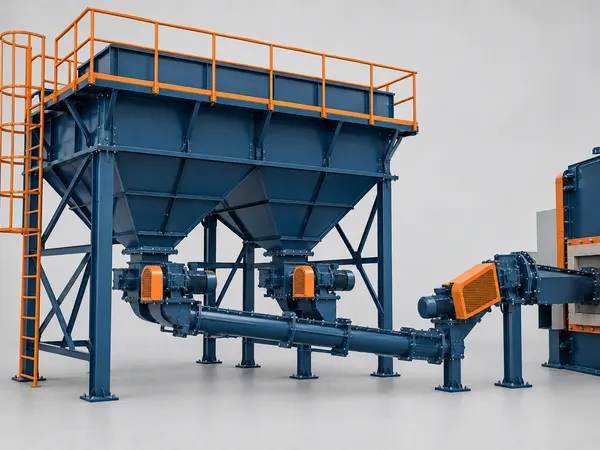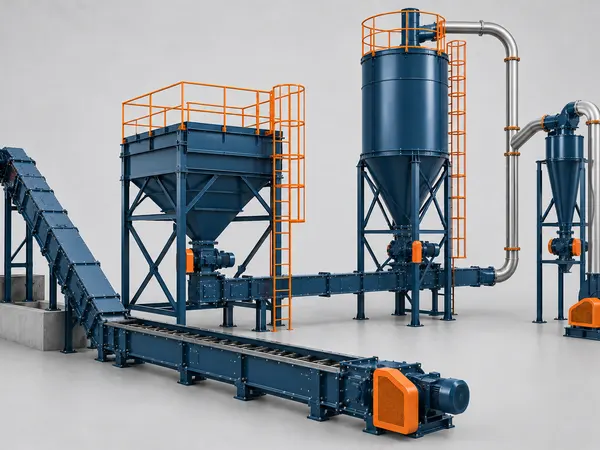
Images are representative illustrations. Products are custom-engineered to your requirement and actual appearance may vary.
Belt Conveyor
We engineer and supply Belt Conveyor as part of complete industrial heating and utility solutions. Share your capacity, fuel type, application, and site details — our team will recommend a suitable configuration and quote.
Buy Belt Conveyor
Built to order and quoted against your duty, so there is no list price. Tell us the capacity, fuel and application by phone or email — we reply within 24 hours.
About Belt Conveyor
A belt conveyor is the workhorse of solid-fuel handling: a continuous belt carried on idlers between a drive pulley and a tail pulley, moving coal, biomass, husk or wood chips from the receiving area to the boiler bunker without the fuel being handled twice. For distances of more than a few meters it is usually the lowest-cost way to move bulk fuel, and it is the conveyor most boiler houses are built around.
Fuel conveyors are designed around the worst fuel the plant will receive, not the specification sheet. Troughing idlers shape the belt so loose material does not spill, and the trough angle, belt width and speed are set by the fuel's bulk density and lump size. Biomass is light and bulky, so a biomass belt is wider or faster than a coal belt carrying the same tonnage.
Inclination is the other deciding factor. A plain belt suits moderate slopes; steeper runs need a chevron or cleated belt, and a vertical lift is a job for a bucket elevator instead. Wet or sticky fuel changes all of this, which is why we ask for the monsoon condition of the fuel, not the dry one.
We design, fabricate and install fuel belt conveyors as part of a boiler package or as a standalone system, with covered galleries, skirt boards, belt scrapers and the pull-cord and belt-sway protection an operator needs to stop the belt safely.
Sizing starts from the fuel the boiler burns at its maximum continuous rating, with margin for the wettest fuel and for the hours in which the plant wants its bunkers filled. Indian practice here follows IS 11592, the code of practice for the selection and design of belt conveyors, which sets out how capacity, belt width, speed and power follow from the material and the route. The same calculation gives the drive rating and the belt tension the take-up has to hold.
Most conveyor trouble happens at the transfer points, not along the run. Fuel should be placed on the belt travelling in the direction of the belt and at close to belt speed; dropped across it or against it, it grinds the top cover, loads the belt off-center and spills. Impact idlers under the loading point, correctly sealed skirt boards, a chute shaped to the fuel and a scraper at the head pulley are what separate a conveyor that stays clean from one that leaves a trail of fuel down the gallery.
A belt that will not run straight is usually reporting a problem with the structure or the loading rather than with the belt. Stringers out of level, a pulley out of square, build-up on a return idler or an off-center load all pull a belt to one side, and training idlers correct what is left. Inclined conveyors carry a backstop so a loaded belt cannot run back if power fails, and splices are vulcanized or mechanical depending on the tension and how quickly the plant needs to repair one.
Typical duty is a rice mill, sugar plant, paper mill, board plant or captive power house moving coal, husk, chips or bagasse from the yard to the bunker. We supply belt conveyors on their own, as a retrofit where fuel is still barrowed by hand, or as one engineered chain with the crusher, screen, bucket elevator, bunker and feeders — including erection, commissioning, operator training, spares and an AMC where the plant wants one.
Belt Conveyor Key Features
- Troughed belt on carrying and return idlers
- Belt width and speed matched to fuel bulk density and lump size
- Plain, chevron or cleated belt selected against the incline
- Gravity or screw take-up to hold belt tension
- Head scraper and skirt boards to control spillage and dust
- Covered galleries for biomass and monsoon operation
- Pull-cord, belt-sway and zero-speed protection
- Magnetic separator and metal detector provision ahead of feeders
- Belt width, speed and drive power derived to IS 11592 practice
- Loading chute, impact idlers and skirt sealing at the feed point
- Training idlers to hold belt tracking over long runs
- Backstop on inclined conveyors against loaded run-back
- Vulcanized or mechanical splicing to suit tension and repair time
- Walkways, handrails and crossovers for safe access along the route
- Belt weigher provision where fuel has to be accounted for
Belt Conveyor Specification
Materials Handled
Belt Conveyor Types
Belt carried on three-roll troughing idlers — the standard arrangement for loose coal and biomass, holding the load in the center of the belt.
Raised profiles on the belt surface stop material sliding back, allowing steeper inclines than a plain belt can carry.
Runs in either direction or travels along its length to distribute fuel into more than one bunker or storage bay.
The whole run is enclosed in a walkway gallery — keeps biomass dry through the monsoon and contains dust across open ground.
Wheel-mounted conveyor for building and reclaiming stockpiles, used where seasonal fuel arrives faster than it is burnt.
Belt Conveyor Applications
Industries Served
Advantages of a Belt Conveyor
For runs beyond a few meters a belt moves bulk fuel with less power and less wear than screw or pneumatic conveying.
Width, speed and belt type are set against the wettest, bulkiest fuel the plant receives, not a nominal sample.
Pull-cord, belt-sway and zero-speed switches let operators stop the conveyor from anywhere along its length.
Supplied with the bunker, feeders and boiler it serves, so capacities match end to end.
Fuel is carried rather than dragged or thrown, so briquettes and pellets reach the bunker whole instead of broken into fines.
Over a straight run a belt moves more fuel per kilowatt than screw or pneumatic conveying, which shows up directly on the plant’s power bill.
The whole run can be walked and inspected, so worn idlers, drifting tracking and spillage are caught long before they stop the boiler.
Optional Accessories
Frequently Asked Questions(10)
What is a belt conveyor used for in a boiler house?
How steep can a fuel belt conveyor run?
Why does a biomass belt need to be bigger than a coal belt?
Should a fuel conveyor be covered?
Do you supply the complete fuel handling system or only the conveyor?
What do you need from us to size a belt conveyor?
Why does fuel spill along the conveyor?
Do you supply the supporting structure and gallery as well?
Can a belt conveyor be retrofitted to an existing boiler house?
What spares should a plant keep for a fuel conveyor?
- Capacity / size requirements
- Process or application details
- Material preference (M.S / S.S where applicable)
- Installation location & delivery timeline
Share your capacity, fuel type, and application — we respond within 24 hours.
After it is installed
Equipment is the start of the relationship, not the end of it. We work from Indore, Madhya Pradesh, for plants across India, and handle installation and commissioning, boiler AMC, retrofits, plant audits, spare parts and operator training — on equipment from any manufacturer, not only our own.
Related products
View more