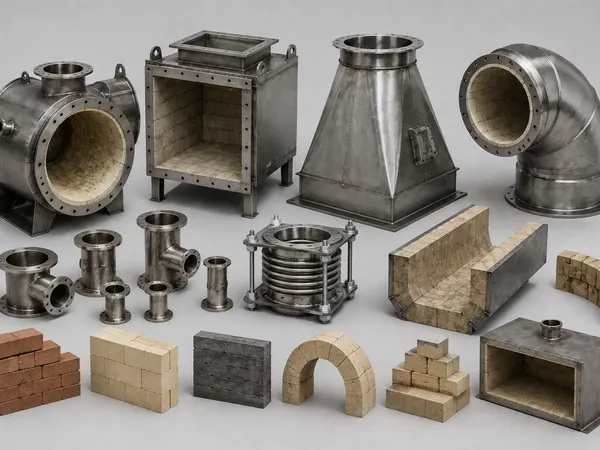
Images are representative illustrations. Products are custom-engineered to your requirement and actual appearance may vary.
Insulation Work
We engineer and supply Insulation Work as part of complete industrial heating and utility solutions. Share your capacity, fuel type, application, and site details — our team will recommend a suitable configuration and quote.
Get a Quote for Insulation Work
Quoted against your scope, so there is no list price. Tell us the site, what the work covers and your timeline by phone or email — we reply within 24 hours.
About Insulation Work
Every uninsulated hot surface in a plant is radiating fuel that has already been paid for. Insulation is among the shortest-payback energy measures in a boiler house, and it is also the one most often deferred, partly because the loss is invisible and continuous rather than sudden.
GyanTosh executes thermal insulation for boilers, thermic fluid heaters, steam and condensate pipework, ducting, chimneys, tanks and vessels. Material selection follows the service temperature — mineral and rock wool through the ordinary range, ceramic fiber where it climbs beyond what wool will tolerate, and calcium silicate where the insulation has to carry load or hold its shape. Thickness follows the economics: enough to cut the loss to a sensible level and to bring the outer surface down to a temperature that will not burn anyone who brushes past it.
Cladding is what makes insulation last. Wool that gets wet loses most of its value and does not recover, so aluminum or galvanized sheet, properly lapped and sealed, is not a finish but part of the system. Valves, flanges and other items that have to be opened are insulated with removable covers, because insulation that has to be destroyed to reach a valve is insulation that never gets replaced after the first maintenance visit.
Insulation Work Key Features
- Boiler, heater, pipework, ducting, chimney, tank and vessel insulation
- Mineral wool, rock wool, ceramic fiber and calcium silicate to suit temperature
- Thickness selected for heat loss and safe touch temperature
- Aluminum and galvanized sheet cladding, lapped and sealed
- Removable covers for valves, flanges and instruments
- Personnel protection on accessible hot surfaces
- Executed on new installations and as a retrofit to existing plant
Insulation Work Specification
Scope of Work
Chosen by service temperature and by whether the insulation has to carry load or hold its shape — wool for the ordinary range, ceramic fiber above it, calcium silicate where rigidity matters.
Set by the heat loss worth eliminating and by the surface temperature a person can safely touch, which are usually two different numbers with the higher one governing.
Fitted, secured and finished so that joints are closed and the insulation stays in contact with the surface it is protecting.
Aluminum or galvanized sheet, lapped to shed water. Wet insulation loses most of its value permanently, so outdoor runs live or die on this step.
Insulation Work Applications
Advantages of Insulation Work
A hot uninsulated surface loses heat continuously, and that heat was bought with fuel. Insulation is typically the shortest-payback measure available in a boiler house.
Thickness is chosen so accessible surfaces can be brushed against without injury, which on a walkway or beside a control station is the governing requirement rather than the economics.
Insulation that gets wet does not recover. Properly lapped and sealed cladding is what makes the difference between insulation that lasts and insulation that is decorative within two monsoons.
Removable covers on valves and flanges mean maintenance does not destroy the insulation — which is the usual reason a well-insulated plant is a poorly-insulated plant three years later.
Optional Accessories
Frequently Asked Questions(4)
Is insulation worth retrofitting to an existing plant?
How thick should insulation be?
Why does insulation fail?
Do you insulate valves and flanges?
- Capacity / size requirements
- Process or application details
- Material preference (M.S / S.S where applicable)
- Installation location & delivery timeline
Share your capacity, fuel type, and application — we respond within 24 hours.
After it is installed
Equipment is the start of the relationship, not the end of it. We work from Indore, Madhya Pradesh, for plants across India, and handle installation and commissioning, boiler AMC, retrofits, plant audits, spare parts and operator training — on equipment from any manufacturer, not only our own.
Related products
View more