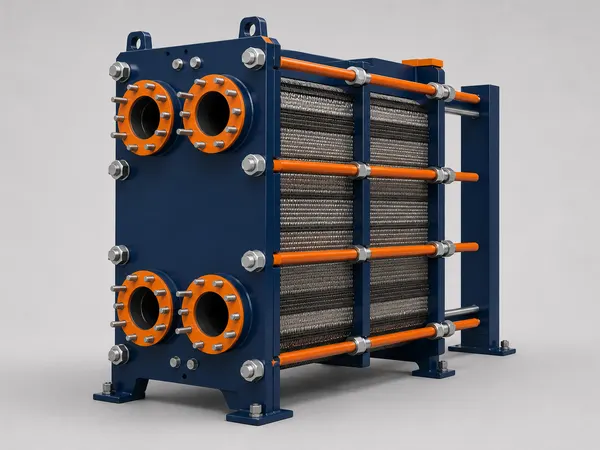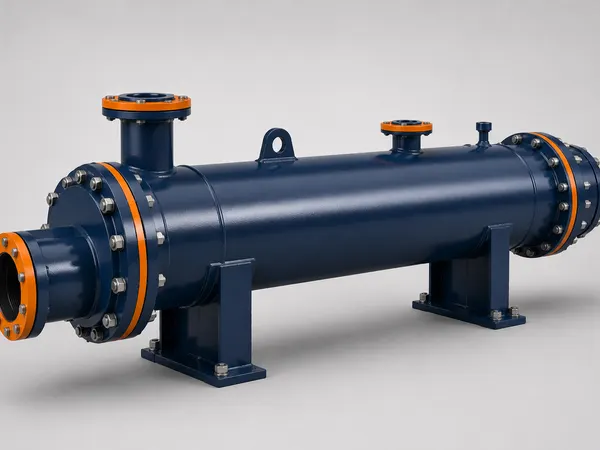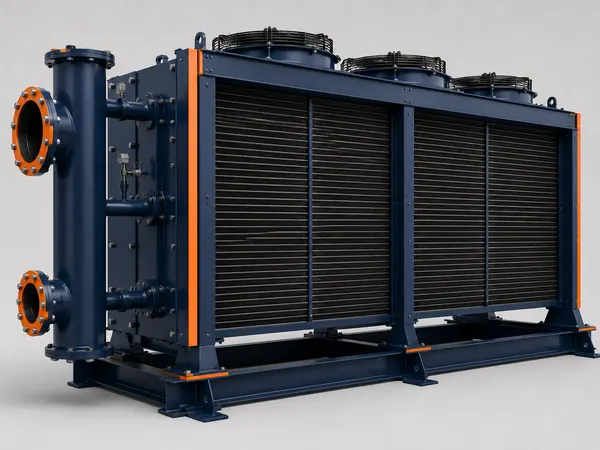
Images are representative illustrations. Products are custom-engineered to your requirement and actual appearance may vary.
Shell and Tube Heat Exchanger Manufacturer
We engineer and supply Shell & Tube Heat Exchanger as part of complete industrial heating and utility solutions. Share your capacity, fuel type, application, and site details — our team will recommend a suitable configuration and quote.
Buy Shell & Tube Heat Exchanger
Built to order and quoted against your duty, so there is no list price. Tell us the capacity, fuel and application by phone or email — we reply within 24 hours.
About Shell & Tube Heat Exchanger
A shell and tube heat exchanger — also called a tubular heat exchanger — is a bundle of tubes inside a cylindrical shell. One fluid passes through the tubes, the other flows around them within the shell, and heat moves through the tube wall without the two ever mixing. Baffles in the shell force cross-flow over the bundle to raise the transfer coefficient and to support the tubes against vibration.
It remains the default choice for industrial duty for one reason: the geometry tolerates conditions that destroy other types. The shell is a straightforward pressure vessel, so high design pressures are routine — which is why, when a specification calls for a high pressure heat exchanger, this is almost always the type it means. There are no gaskets in the primary flow path, so high temperatures and thermal cycling are acceptable. The tube side can be mechanically cleaned, so fouling fluids are manageable rather than fatal.
The cost of that robustness is size and metal. For a given duty a shell and tube unit occupies several times the volume of a plate pack and weighs considerably more, and achieving a close temperature approach requires either a long unit or several in series. Where pressure and temperature are modest and the fluids are clean, a plate exchanger will almost always be smaller and cheaper.
Configuration is where the engineering sits. Fixed tubesheet construction is the simplest and cheapest but cannot accommodate differential thermal expansion between shell and tubes; a U-tube bundle or a floating head is specified where that expansion has to go somewhere, and a removable bundle is specified where the shell side will need cleaning. Getting that choice wrong is expensive to correct after fabrication.
Shell and tube heat exchangers are the default across process industry for a reason: they take pressure, they take temperature, they take dirty fluids, and they can be opened and cleaned. An industrial shell and tube heat exchanger is specified from the duty rather than the catalog — the two fluids, their flow rates, inlet and outlet temperatures and design pressure are what determine tube count, length, pass arrangement and shell diameter.
Shell & Tube Heat Exchanger Key Features
- Tube bundle within a cylindrical shell, no gaskets in the primary flow path
- High design pressure and temperature capability
- Tube side mechanically cleanable — tolerates fouling service
- Fixed tubesheet, U-tube and floating head configurations
- Single and multi-pass tube side arrangements for close approach
- Baffled shell side for cross-flow and tube support
- Wide material choice — carbon steel, stainless, alloy tubes as duty requires
- Repairable in service: individual tubes can be plugged or replaced
Service Fluids
Construction Type
Tubesheets welded to the shell at both ends. Simplest and lowest cost, with no shell-side access for mechanical cleaning. Suits clean shell-side fluids and modest temperature differences.
Tubes bent into a U so the bundle is fixed at one end only, absorbing differential expansion freely. The bends cannot be mechanically cleaned, so the tube side must be a clean fluid.
One tubesheet free to move within the shell, accommodating expansion while allowing the bundle to be withdrawn for cleaning on both sides. The most flexible and most expensive configuration.
Shell & Tube Heat Exchanger Applications
Advantages of a Shell & Tube Heat Exchanger
A welded shell and tubesheet assembly carries design pressures well beyond what a gasketed plate pack can hold, which is why high-pressure duty defaults to this type.
Straight tubes can be rodded or hydro-jetted, so fluids that would block a plate channel remain serviceable over a normal cleaning cycle.
No gaskets in the primary path means rapid temperature swings and start-stop cycling are absorbed without a sealing failure.
A failed tube can be plugged or replaced in situ, so a leak does not condemn the whole exchanger.
Optional Accessories
Frequently Asked Questions(8)
When should I choose shell and tube over a plate heat exchanger?
What is the difference between fixed tubesheet, U-tube and floating head?
Which fluid should go on the tube side?
Can a shell and tube exchanger be repaired if a tube leaks?
What is the shell and tube heat exchanger working principle?
How is shell and tube heat exchanger sizing done?
What drives shell and tube heat exchanger design?
What determines shell and tube heat exchanger price?
- Capacity / size requirements
- Process or application details
- Material preference (M.S / S.S where applicable)
- Installation location & delivery timeline
Share your capacity, fuel type, and application — we respond within 24 hours.
After it is installed
Equipment is the start of the relationship, not the end of it. We work from Indore, Madhya Pradesh, for plants across India, and handle installation and commissioning, boiler AMC, retrofits, plant audits, spare parts and operator training — on equipment from any manufacturer, not only our own.