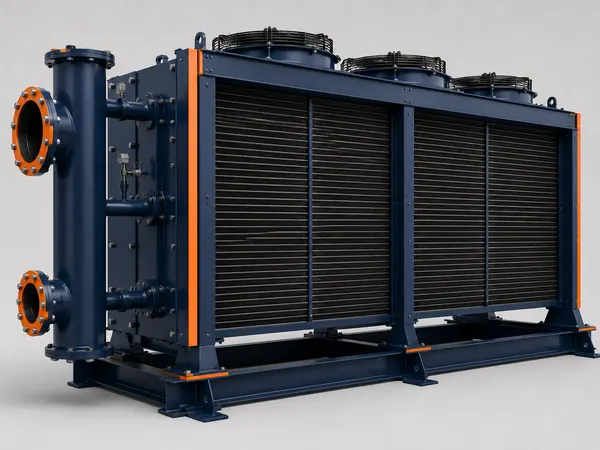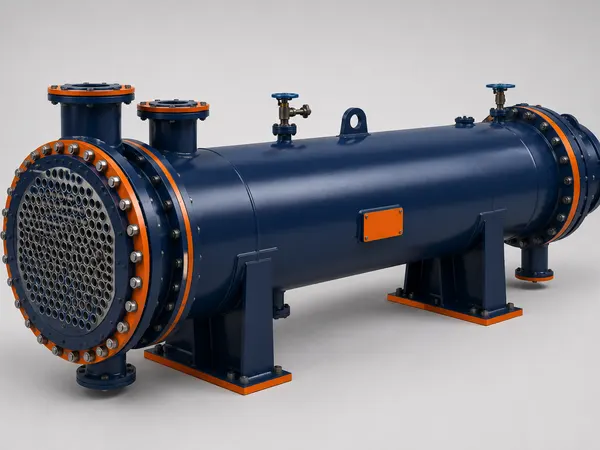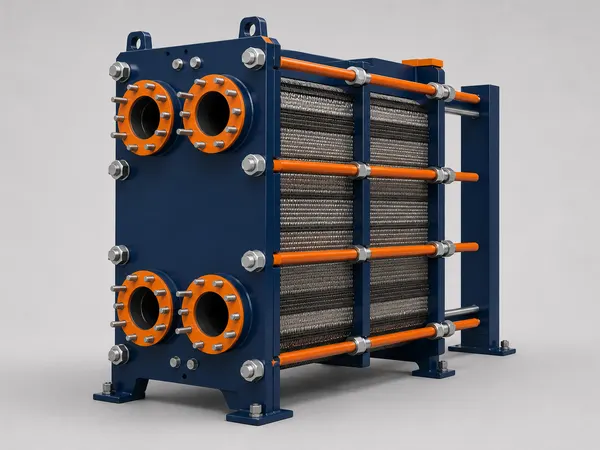
Images are representative illustrations. Products are custom-engineered to your requirement and actual appearance may vary.
Double Pipe Heat Exchanger
We engineer and supply Double Pipe Heat Exchanger as part of complete industrial heating and utility solutions. Share your capacity, fuel type, application, and site details — our team will recommend a suitable configuration and quote.
Buy Double Pipe Heat Exchanger
Built to order and quoted against your duty, so there is no list price. Tell us the capacity, fuel and application by phone or email — we reply within 24 hours.
About Double Pipe Heat Exchanger
A double pipe heat exchanger is the simplest arrangement that works: one pipe inside another. The process fluid flows through the inner pipe, the service fluid through the annulus between the two, and the assembly is usually bent into a hairpin so both connections sit at one end. Several hairpins are connected in series or parallel to build up surface area.
Its value is true counter-current flow. Because the two streams run in opposite directions along a single path, with none of the flow reversal that baffles and multi-pass tube arrangements introduce, the temperature approach achievable is limited only by surface area. Where a process needs the cold outlet to come close to the hot inlet, this geometry does it more predictably than any other.
It also has almost nothing to fail. No baffles, no gaskets in the flow path, no tubesheet, and a small number of welds. That makes it well suited to high pressures, corrosive service in exotic alloys where a large unit would be prohibitively expensive, and duties where a leak would be serious.
The limit is scale. Surface area grows only by adding hairpins, and each brings its own pipework, supports and pressure drop. Past a modest area a shell and tube unit delivers the same duty in less space and at lower cost. Double pipe is specified where the duty is small, the pressure is high, the approach must be close, or the material is expensive enough that a compact unit matters more than a cheap one.
Also called a double tube heat exchanger, the arrangement is the simplest there is: one pipe inside another, with one fluid in the inner pipe and the other in the annulus between them. That simplicity is the point — true counter-current flow, no gaskets in the primary path, and a unit that can be added to in sections as duty grows.
Double Pipe Heat Exchanger Key Features
- Pipe-within-a-pipe hairpin construction — minimal component count
- True counter-current flow for predictable close approach
- High design pressure capability on both sides
- Surface area extended by adding hairpins in series or parallel
- Straightforward mechanical cleaning of the inner pipe
- Economical in exotic alloys where a large unit would not be
- Compact for small duties and easily accommodated in existing pipework
- Optional longitudinal fins on the inner pipe to boost annulus-side transfer
Service Fluids
Configuration
Bare inner pipe within an outer pipe. The simplest form, used where both fluids are liquids with comparable transfer coefficients.
Fins along the inner pipe multiply the annulus-side surface, used when the annulus fluid transfers heat far less readily than the inner one — commonly a gas or a viscous liquid.
Several inner tubes within one outer shell, an intermediate step where a single hairpin no longer suffices but a shell and tube unit is not yet justified.
Double Pipe Heat Exchanger Applications
Industries Served
Advantages of a Double Pipe Heat Exchanger
True counter-current flow with no internal reversal means the approach is limited by surface area alone, not by the geometry of the exchanger.
Two concentric pipes are inherently strong; there is no tubesheet or gasket to become the limiting component.
Where corrosion demands an exotic alloy, a small double pipe unit costs a fraction of the equivalent surface in a shell and tube exchanger.
Few components and few welds mean fewer failure modes, which matters where a leak between the two fluids would be serious.
Optional Accessories
Frequently Asked Questions(7)
When is a double pipe exchanger preferable to shell and tube?
How is capacity increased?
Why are fins fitted to the inner pipe?
Can it handle fouling fluids?
What is the application of a double pipe heat exchanger?
What are the double pipe heat exchanger types?
How is double tube heat exchanger design approached?
- Capacity / size requirements
- Process or application details
- Material preference (M.S / S.S where applicable)
- Installation location & delivery timeline
Share your capacity, fuel type, and application — we respond within 24 hours.
After it is installed
Equipment is the start of the relationship, not the end of it. We work from Indore, Madhya Pradesh, for plants across India, and handle installation and commissioning, boiler AMC, retrofits, plant audits, spare parts and operator training — on equipment from any manufacturer, not only our own.