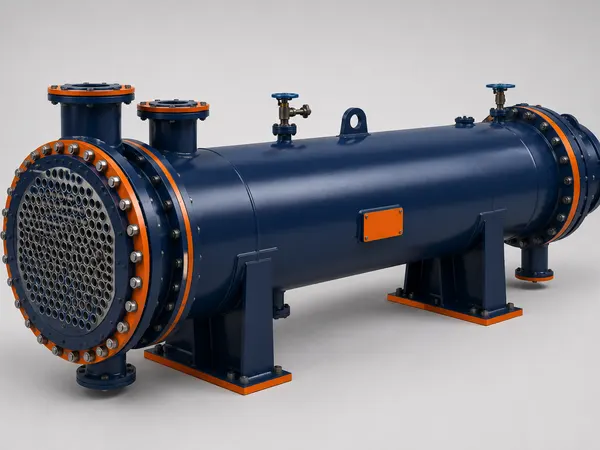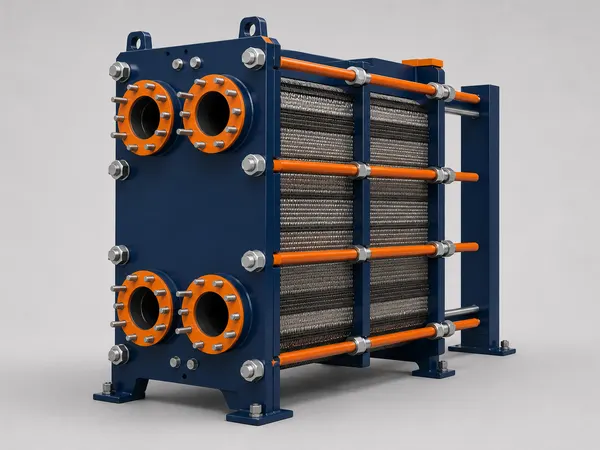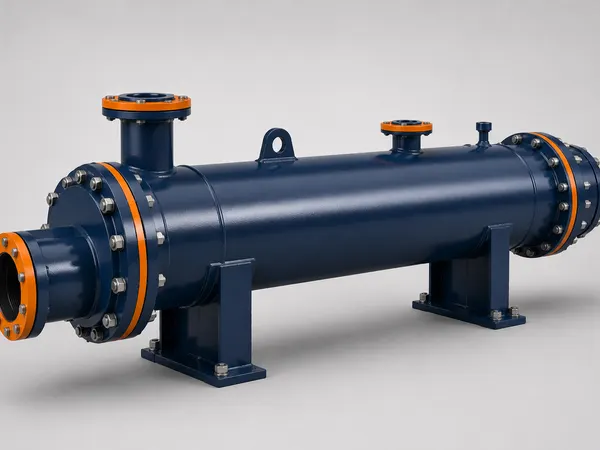
Images are representative illustrations. Products are custom-engineered to your requirement and actual appearance may vary.
Finned Tube Heat Exchanger Manufacturer
We engineer and supply Finned Tube Heat Exchanger as part of complete industrial heating and utility solutions. Share your capacity, fuel type, application, and site details — our team will recommend a suitable configuration and quote.
Buy Finned Tube Heat Exchanger
Built to order and quoted against your duty, so there is no list price. Tell us the capacity, fuel and application by phone or email — we reply within 24 hours.
About Finned Tube Heat Exchanger
A finned tube heat exchanger exists to solve a specific imbalance. When one of the two fluids is air or gas, its heat transfer coefficient is an order of magnitude below that of a liquid, so the gas side governs the whole exchanger no matter how good the liquid side is. Fins bonded to the outside of the tubes multiply the gas-side surface — often by a factor of ten or more — until the two sides are comparable.
That single idea makes a family of equipment possible. Air-cooled condensers and coolers reject heat to atmosphere where cooling water is scarce, expensive or restricted, removing a cooling tower and its water treatment, blowdown and drift losses from the plant entirely. Economizers recover heat from boiler flue gas into feed water. Air preheaters return it to combustion air. Process air heaters raise the temperature of a moving air stream for drying and curing duty.
The same equipment goes by several names: a fin and tube heat exchanger, a finned pipe heat exchanger, a finned coil heat exchanger, or a fin tube type heat exchanger. Fins usually run around the tube, which suits air and flue gas crossing a tube bank; a longitudinal finned tube heat exchanger runs them along the tube instead, for flow parallel to it.
Fin geometry is the engineering decision. Fin pitch, height and bonding method are chosen against the gas stream: widely spaced, robust fins where the gas carries dust or soot and the surface will need cleaning; tight, tall fins where the gas is clean and maximum surface matters. Specifying a fine fin pitch for a dusty flue gas produces an exchanger that blocks solid within months and loses the duty it was bought for.
Fouling on the gas side is the dominant operating concern, because deposits between fins are hard to reach and their insulating effect is severe. Access for cleaning, and sometimes soot blowers, belong in the design rather than being retrofitted after performance falls away.
Finned Tube Heat Exchanger Key Features
- Extended gas-side surface — commonly ten times the bare tube area
- Air-cooled operation removes cooling water demand entirely
- Fin pitch and height selected against gas cleanliness and fouling risk
- Bonding by tension winding, embedding, welding or extrusion as duty requires
- Suits flue gas heat recovery, economizer and air preheater duty
- Forced or induced draft fan arrangements
- Modular bundle construction for staged capacity
- Materials matched to gas-side corrosion and acid dew point risk
Gas-Side Media
Fin Construction
Strip wound under tension into a groove on the tube. Economical and widely used for moderate temperature duty where thermal cycling is limited.
Fin foot embedded into a machined groove, giving a mechanically locked bond that survives higher temperatures and repeated thermal cycling without loosening.
Metallurgically bonded or formed from the tube's own outer sleeve. The most robust and most expensive, specified for high temperature, corrosive or heavily cycled service.
Finned Tube Heat Exchanger Applications
Advantages of a Finned Tube Heat Exchanger
Rejecting heat to air eliminates the cooling tower, its make-up water, treatment, blowdown and drift losses — decisive where water is scarce or discharge is regulated.
Extended surface turns flue gas and exhaust streams into recoverable heat, which is where most straightforward fuel savings in an existing plant are still available.
Pitch and height chosen against dust loading and cleaning access, so the exchanger keeps its duty instead of blinding over within a season.
Bundle construction allows capacity to be added in steps and individual bundles to be replaced without rebuilding the installation.
Optional Accessories
Frequently Asked Questions(4)
Why are fins only on the gas side?
How is fin pitch selected?
What limits flue gas heat recovery?
Is air cooling less efficient than water cooling?
- Capacity / size requirements
- Process or application details
- Material preference (M.S / S.S where applicable)
- Installation location & delivery timeline
Share your capacity, fuel type, and application — we respond within 24 hours.
After it is installed
Equipment is the start of the relationship, not the end of it. We work from Indore, Madhya Pradesh, for plants across India, and handle installation and commissioning, boiler AMC, retrofits, plant audits, spare parts and operator training — on equipment from any manufacturer, not only our own.