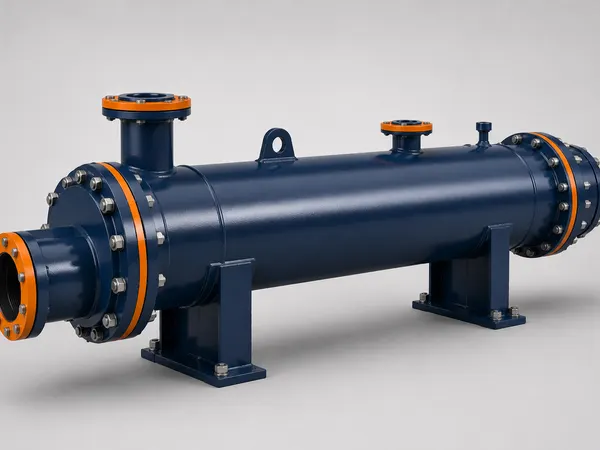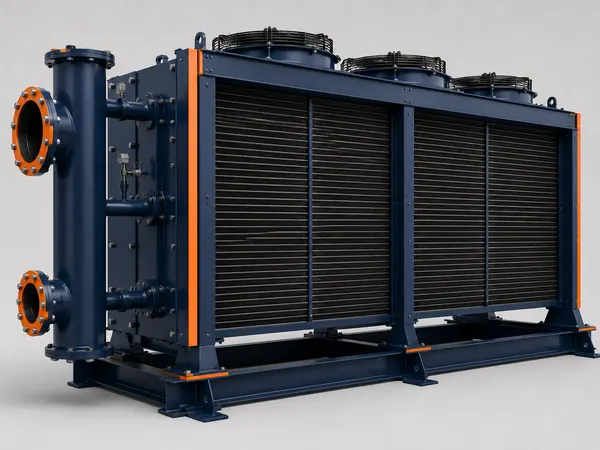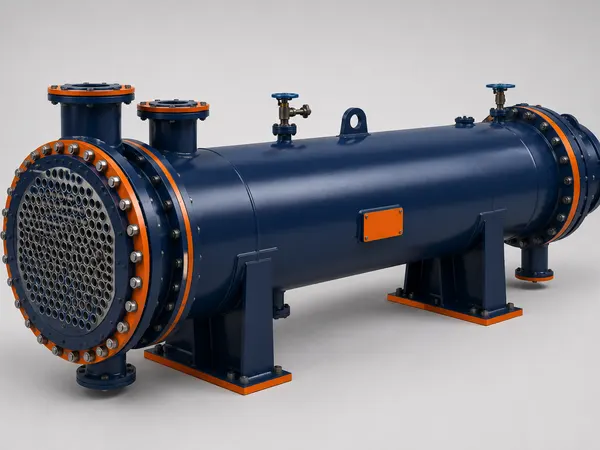
Images are representative illustrations. Products are custom-engineered to your requirement and actual appearance may vary.
Plate and Frame Heat Exchanger Manufacturers
We engineer and supply Plate & Frame Heat Exchanger as part of complete industrial heating and utility solutions. Share your capacity, fuel type, application, and site details — our team will recommend a suitable configuration and quote.
Buy Plate & Frame Heat Exchanger
Built to order and quoted against your duty, so there is no list price. Tell us the capacity, fuel and application by phone or email — we reply within 24 hours.
About Plate & Frame Heat Exchanger
A plate and frame heat exchanger is a stack of thin corrugated metal plates clamped between a fixed and a moveable frame. Gaskets around each plate direct the two fluids into alternating channels, so every plate has hot fluid on one face and cold on the other. The corrugations induce turbulence at low flow velocities and hold the plates apart under pressure.
The result is a heat transfer coefficient three to five times that of a shell and tube unit, in perhaps a fifth of the volume for the same duty. Because the flow is genuinely counter-current across a large number of thin channels, temperature approaches of a few degrees become practical — recovering heat that a shell and tube exchanger would leave in the effluent.
It is also the only common type whose capacity can be changed after purchase. Adding plates to the frame increases surface area; removing them reduces it. Where a process is expected to grow, specifying a frame with spare capacity is far cheaper than replacing an exchanger later.
The constraints are all consequences of the gaskets. Design pressure and temperature ceilings are well below shell and tube capability, elastomer selection must match both fluids and the temperature, and the narrow channels block if the fluid carries fibers or particles. Gaskets are a consumable with a finite life. Against that, the whole pack opens for inspection and cleaning in an hour, which is far faster than pulling a tube bundle.
Plate & Frame Heat Exchanger Key Features
- Corrugated plate pack in a bolted frame — compact for the duty
- High turbulence and heat transfer coefficient at low flow velocity
- True counter-current flow enabling close temperature approach
- Surface area changed by adding or removing plates
- Opens fully for inspection and cleaning without specialist tooling
- Low hold-up volume and fast thermal response
- Gasket material selected to suit both fluids and temperature
- Stainless steel and higher alloy plates as corrosion duty requires
Service Fluids
Plate Pack Type
The standard construction. Fully openable for cleaning and expandable by adding plates, with pressure and temperature limited by the gasket material.
Multi-pass plate arrangement used where the process demands the outlet temperatures approach each other within a few degrees, which shell and tube geometry struggles to achieve in one unit.
Plate & Frame Heat Exchanger Applications
Advantages of a Plate & Frame Heat Exchanger
Three to five times the transfer coefficient of a shell and tube unit means a plant room can accommodate duty that would otherwise need a much larger vessel.
Close temperature approach makes low-grade recovery viable — waste streams a shell and tube unit could not economically reach.
Adding plates to an existing frame increases duty without replacing the exchanger, which is unique among the common types.
The pack opens for inspection and cleaning without specialist equipment, and plates can be cleaned individually rather than in place.
Optional Accessories
Frequently Asked Questions(4)
Can a plate heat exchanger handle steam?
How often do the gaskets need replacing?
Can capacity be increased later?
What fluids are unsuitable?
- Capacity / size requirements
- Process or application details
- Material preference (M.S / S.S where applicable)
- Installation location & delivery timeline
Share your capacity, fuel type, and application — we respond within 24 hours.
After it is installed
Equipment is the start of the relationship, not the end of it. We work from Indore, Madhya Pradesh, for plants across India, and handle installation and commissioning, boiler AMC, retrofits, plant audits, spare parts and operator training — on equipment from any manufacturer, not only our own.