
Boiler Efficiency: How It Is Calculated, What Lowers It, and How to Raise It
Boiler efficiency is the share of the fuel’s heat that ends up in the steam. The number itself is easy to state and easy to misread: it depends on how it was measured, at what load, and against which calorific value. This is how it works, with every figure sourced.
16 min read

What boiler efficiency measures
Boiler efficiency is the heat that ends up in the steam, divided by the heat in the fuel that was burned, as a percentage. The Bureau of Energy Efficiency (BEE) defines it exactly that way, and adds a second, simpler measure plant people use every day: the evaporation ratio, kilograms of steam per kilogram of fuel.
Everything that is not useful heat is a loss. Most of it leaves up the chimney, as hot dry gas and as water vapor. Some is lost as unburnt fuel, some as heat radiating from the boiler shell, and some as hot water drained off in blowdown. Efficiency is therefore never a property of the boiler alone. The same shell gives a different figure on a different fuel, at a different load, or with a burner that has drifted out of tune.
In India, efficiency is normally stated on the gross calorific value (GCV) of the fuel. The British test standard BS 845 does the same, and so do BEE’s worked examples. Some manufacturers quote on net calorific value (NCV) instead, which makes the same boiler look five to nine points better. That difference is explained further down, because it is the single most common way two quotations fail to compare.
How to calculate boiler efficiency: the direct method
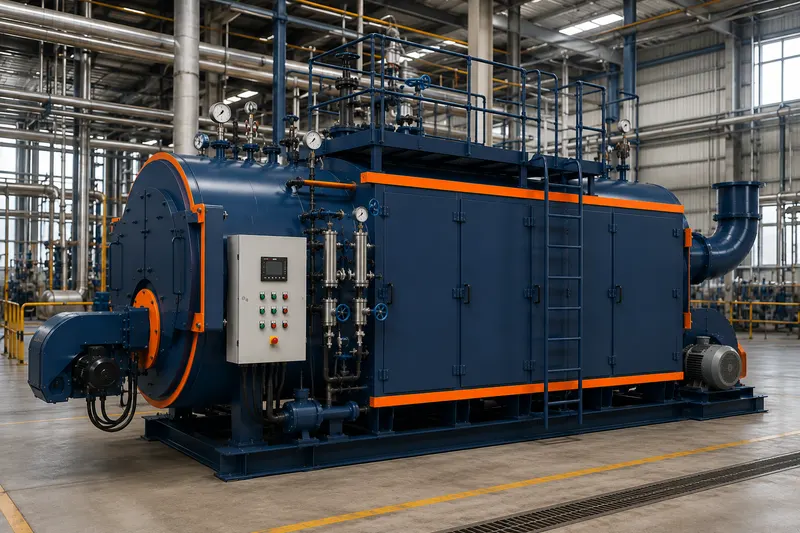
The direct method, also called the input-output method, is the simplest boiler efficiency calculation: it measures what went in and what came out. The boiler efficiency formula is: efficiency = steam flow × (steam enthalpy − feedwater enthalpy) × 100 ÷ (fuel flow × GCV). Enthalpies are in kcal/kg, flows in kg/h, and GCV in kcal/kg of fuel.
BEE’s worked example: a coal-fired boiler makes 8 tonnes of steam an hour at 10 kg/cm²(g), from feedwater at 85 °C, burning 1.6 tonnes of coal with a GCV of 4,000 kcal/kg. Steam enthalpy is 665 kcal/kg and feedwater 85 kcal/kg, so efficiency = 8,000 × (665 − 85) × 100 ÷ (1,600 × 4,000) = 72.5%. The evaporation ratio is 8 ÷ 1.6 = 5. As a cross-check, the IAPWS-IF97 formulation behind our steam table gives 664.4 kcal/kg for that steam, so BEE’s rounded figure holds.
The strength of the direct method is that it needs only four measurements, and it reflects the plant as it actually runs. Its weakness is that it tells you the efficiency is low without saying why. It is also sensitive to measurement error: BEE points out that on a 90% boiler, a 1% error in the direct method moves the answer by 0.9 points, while the same error in the indirect method moves it by only 0.1.
The indirect method, and where the heat goes
The indirect method, or heat-loss method, measures each loss separately and subtracts their total from 100. It needs a fuel analysis (carbon, hydrogen, moisture, ash), a flue gas analysis (oxygen or CO₂, and CO), flue gas and ambient temperatures, and the unburnt carbon in the ash. In return, it tells you exactly where the heat is going, which is the only information you can act on.
BEE lists the losses as: dry flue gas; water vapor formed from the fuel’s hydrogen; moisture in the fuel; moisture in the combustion air; carbon burnt only to carbon monoxide; radiation and convection from the boiler surface; and unburnt carbon in fly ash and bottom ash.
The chart at the top of this page is BEE’s two worked heat balances. The coal-fired boiler reaches 77.8%. Its largest loss is dry flue gas at 7.9%, followed by 5.9% spent evaporating the 31.6% moisture in the coal and 2.6% lost as carbon monoxide. The furnace-oil boiler reaches 84.3%, but loses 7.1% to the water vapor formed from the oil’s 12% hydrogen, nearly as much as its dry flue gas loss. That hydrogen loss matters again later, when we get to gross and net calorific value.
We recomputed both balances from BEE’s published inputs rather than copying the totals. The losses add to 22.23% and 15.73%, reproducing BEE’s 77.77% and 84.27% exactly.
How boiler efficiency has evolved
A history of the steam boiler written at Loughborough University in 1981 puts early boilers of around 1800 at about 30% efficient. By about 1900, Lancashire boilers fitted with superheaters were claiming 73.4%. Pulverized-fuel firing, tested at Barton power station in the 1920s, reached 84.2% gross. Drakelow A in the 1950s achieved 86%, a large reheat unit in the 1960s 90.0%, and a test at Drax had recorded 94.8% by the time the thesis was written.
Those are power-station boilers, and they are not what a process plant buys. A utility boiler has room for economizers, air heaters and every other refinement, because each point of efficiency is worth a great deal at that scale. An industrial boiler of a few tonnes an hour is a different machine, and BEE’s own worked examples put coal and furnace oil at 77.8% and 84.3%. Compare efficiency within a class of boiler, never across one.
What moved the numbers over two centuries was not one invention but the steady removal of losses: internal furnaces, then superheaters, then economizers, then pulverized fuel and air heaters, then closer combustion control. The losses have not changed in kind since. The same list applies to a boiler installed today.

Factors affecting boiler efficiency
BEE lists the factors that move a boiler’s efficiency in service: cleanliness of the heat transfer surfaces, soot blowing, water treatment and blowdown control, draft control, excess air, the percentage loading of the boiler, steam pressure and temperature, insulation, and fuel quality. They matter in roughly this order of size.
- Stack temperature. Heat that leaves in the flue gas is the largest single loss. UNEP and the US Department of Energy (DOE) agree that each 22 °C (40 °F) of flue gas temperature is worth about one point of efficiency.
- Excess air. Some excess air is needed for complete combustion, but every kilogram of air beyond that is heated and thrown up the chimney. In DOE’s natural gas table, cutting flue gas oxygen from 7% to 2%, with the flue gas 222 °C hotter than the combustion air, gains 2.6 points.
- Incomplete combustion. Too little air leaves carbon monoxide and unburnt carbon. In BEE’s coal example, CO alone cost 2.6% and unburnt carbon in the bottom ash another 1.8%.
- Fuel moisture and hydrogen. Water in the fuel, and water formed from its hydrogen, leave as vapor carrying their latent heat. Wet biomass and high-moisture coal pay this loss every hour; it cannot be tuned away, only reduced by drying or storing fuel under cover.
- Scale and soot. Deposits insulate the heat transfer surface, so more heat leaves in the flue gas. UNEP puts 3 mm of soot at 2.5% more fuel.
- Load. A boiler loses a fixed amount of heat from its shell whatever it produces, so the loss grows as a share of output as the load falls.
- Blowdown. Water drained to control dissolved solids leaves at boiler temperature. UNEP gives 10% blowdown at 15 kg/cm² as a 3% efficiency loss; recomputing that with IAPWS-IF97 steam properties gives 2.95%.


How to increase boiler efficiency
The measures below are listed roughly in order of what they are usually worth, with the rule of thumb each source gives. Treat the rules as approximations: they are averages across fuels and boilers, and the chart shows where the sources disagree.
- Tune combustion to the lowest excess air that still burns the fuel completely, and keep it there. Check with a flue gas analyser that reads CO as well as oxygen. On boilers with variable load or fuel, an oxygen trim system does this continuously.
- Fit an economizer to heat the feedwater with flue gas. UNEP’s rule is one percent of fuel for every 6 °C of feedwater temperature, and DOE puts typical economizer savings at 5 to 10% of fuel.
- Preheat the combustion air where an economizer is not enough. UNEP gives one percent of fuel for every 20 °C of air temperature.
- Return condensate. It is already hot and already treated, so it raises feedwater temperature and cuts blowdown at the same time.
- Control blowdown on conductivity rather than by timer, and recover heat from what you do blow down. UNEP notes blowdown heat recovery can return up to 80% of the energy in it.
- Keep surfaces clean. Water treatment prevents scale; soot blowing or cleaning removes soot. UNEP’s signal: when the stack runs about 20 °C hotter than after the last clean, it is time to clean again.
- Run fewer boilers at higher load. UNEP puts the optimum at 65 to 85% of full load, and says operation below 25% should be avoided.
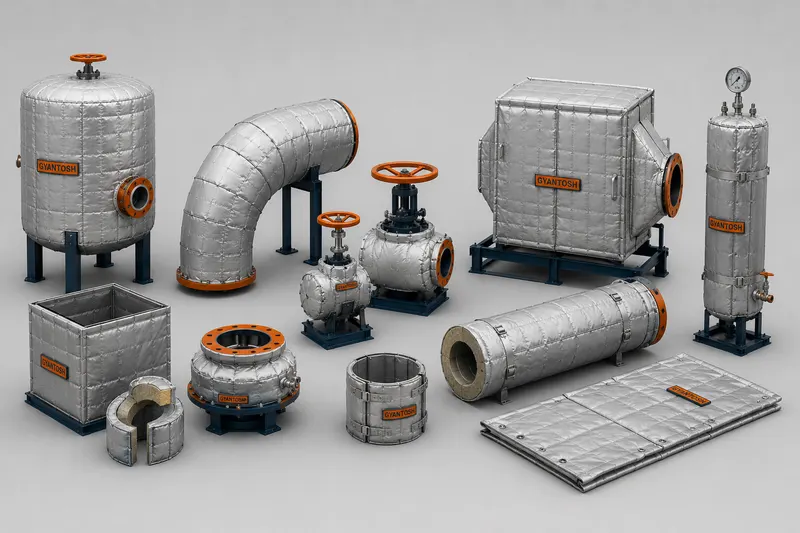
- Insulate the shell, valves and fittings, and repair lagging that has been removed for maintenance and never replaced.
- Lower the steam pressure where the process allows. UNEP estimates 1 to 2% fuel saving, but warns against reducing by more than 20% at once.

What the experts aren’t telling you
None of this is secret. It is simply rarely said out loud in a sales conversation, and each point changes how an efficiency figure should be read.
The same boiler has two efficiencies. Gross calorific value counts the heat that could be recovered by condensing the water vapor in the flue gas; net calorific value leaves it out. A boiler never condenses that vapor, so on a gross basis the loss shows up, and on a net basis it quietly disappears. Recomputed from BEE’s fuel analyses, the coal boiler is 77.8% gross and 84.8% net; the furnace-oil boiler 84.3% gross and 90.0% net. For natural gas, an 85% gross reading becomes 94.3% net. Nothing about the boiler changed. A quotation that does not say which basis it uses has not told you its efficiency.
The quoted figure is usually the best one the boiler will ever achieve. An indirect-method figure is typically measured with the boiler freshly tuned, clean, at full load, on known fuel. Forbes Marshall lists why the fuel bill then disagrees with it: the boiler rarely runs at full load, it cycles on and off, each start purges hot gas up the stack, blowdown is not counted, ambient temperature moves, and solid fuel varies in moisture and calorific value from lorry to lorry. The direct method, run over a week of real operation, is the number that matches your fuel bill.
The rules of thumb disagree with each other. UNEP’s guide says in one section that each 1% reduction in excess air gives about 0.6% more efficiency, and in another that it takes a 5% reduction to gain 1%. DOE says 15%. All three are approximations of the same curve on different fuels and at different starting points. For your own boiler, measure oxygen and stack temperature and work it out, rather than trusting any single rule.
The popular scale figure is the worst case. “1 mm of scale means 5 to 8% more fuel” appears everywhere. The DOE table behind it gives about 2% for 0.8 mm of normal scale, and 7% only for iron-and-silica scale from high-pressure service. Scale is still worth preventing, not least because it overheats tubes, but the saving from descaling a low-pressure boiler is usually smaller than the brochure suggests.
Peak efficiency is not at full load. UNEP places the best efficiency at about two-thirds of full load, falling significantly below a quarter. An oversized boiler, bought with a generous margin, can spend its whole life in the zone where its efficiency is worst.

Things to know before you compare efficiency claims
An efficiency figure is only comparable when these questions have the same answers. Ask them of every quotation.
- Which basis: gross or net calorific value? On gas, the difference is about nine points.
- Which method: direct or indirect? And under which standard, BS 845 or ASME PTC 4?
- At what load? Full load, or the load your process actually runs at?
- On which fuel, with what analysis? Moisture and ash in solid fuel move the figure by several points.
- With what feedwater temperature, excess air and stack temperature assumed?
- Is the guarantee a test result on your site, or a design figure from the drawing office?
- Does the figure include blowdown, and radiation loss at your real load?
What not to do
Most efficiency mistakes come from pushing one measure past the point where it causes a different problem.
- Do not cool the flue gas below its acid dew point. DOE gives minimum stack temperatures of about 121 °C (250 °F) for natural gas, 149 °C (300 °F) for coal and low-sulfur oil, and 177 °C (350 °F) for high-sulfur oil. Below them, acid condenses and corrodes the economizer and the stack.
- Do not cut excess air by watching oxygen alone. Without a CO reading, an operator chasing low oxygen can starve the flame and lose more to unburnt fuel than was saved in flue gas.
- Do not blow down on a timer. Blowdown should follow the dissolved solids in the boiler water, measured, not the clock.
- Do not drop steam pressure sharply to save fuel. UNEP warns it can cause water carryover: at lower pressure the same mass of steam takes up more volume and leaves faster. Reduce in stages, and by no more than 20%.
- Do not buy a boiler much larger than the load. It will spend its life at low load, where the shell loss is proportionally highest and burners need more excess air.
- Do not compare a gross figure with a net one, or a tuned full-load indirect figure with a month of fuel bills.
- Do not treat a rule of thumb as a measurement. Every rule on this page is an average; your boiler’s flue gas analyser is not.