
India's Carbon Credit Trading Scheme: What It Means for Your Boiler
India's carbon market now sets a binding emission-intensity target for 490 named plants, including 52 pulp and paper mills and 173 textile units. It counts the fossil fuel your boiler burns, it does not count biomass, and missing the target costs twice the market price of the shortfall. Here is how it works, from the notified rules.
9 min read

The short version
India now has a compliance carbon market. Under the Carbon Credit Trading Scheme, 2023, the Central Government names individual plants and gives each one a target for its greenhouse gas emission intensity — tonnes of CO2-equivalent per tonne of product — for 2025–26 and 2026–27, measured against its own 2023–24 baseline. A plant that beats its target earns carbon credit certificates it can sell; a plant that misses it must buy certificates or pay environmental compensation at twice their market price.
For most of these plants the boiler is where the counted tonnes are. The rules count every tonne of coal, lignite, petcoke, oil or gas burnt in a boiler, and they do not count biomass: the Bureau of Energy Efficiency's procedure says emissions from biomass and biogenic fuel are “not included in overall emissions but shall be reported as biogenic emissions separately.” That single line is why the fuel a boiler burns has become a compliance decision, not only a cost one.
Who is covered — and who is not
Coverage is by name, not by sector. Each target-setting notification carries a Schedule listing every obligated plant with its registration number, baseline output, baseline intensity and a target for each compliance year. The first notification, G.S.R. 739(E) of 8 October 2025, covered aluminum, cement, chlor-alkali and pulp and paper. A second notification in January 2026 added petroleum refineries, petrochemicals, textiles and secondary aluminum, taking the total to 490 obligated entities, 173 of them textile units across spinning, processing, fiber and composites.
If your plant is not named in a Schedule, it has no target in this cycle, whatever its size or its sector. That includes most rice mills, food plants and small process houses running a single boiler. The scheme does let a non-obligated buyer register and purchase certificates voluntarily, and the sectors covered have already widened once — but nothing in the current rules obliges an unlisted plant to do anything.
What gets counted
The count is gate to gate. Section 3.4 of BEE's Detailed Procedure for Compliance Mechanism defines direct emissions as those “from combustion of any type of fuel (fossil) burnt in stationary (fixed) equipment, such as boilers, gas turbines, kiln, or furnaces to generate heat, mechanical work, and steam,” and indirect emissions as those from “electricity purchased from grid” and from electricity and heat imported into the plant. For targets within 2024–27, only those two are used; emissions from chemical process reactions come in from the following trajectory.
Grid electricity is converted at the Central Electricity Authority's published average grid emission factor, unless the plant has a dedicated power purchase agreement with a verified supplier-specific factor. Fuel is converted from its quantity and net calorific value, using either the default factors in the procedure's Annexure IV — 96.1 tonnes of CO2 per terajoule for other bituminous coal, 101.0 for sub-bituminous, 107.0 for lignite, 97.5 for petcoke — or plant-specific factors from laboratory analysis of the fuel actually burnt.
Section 3.4(3) then lists what is left out: emissions from biomass or biogenic sources of energy, energy from renewable sources, emissions captured by carbon capture and storage, energy used in the plant's colony and for outside transport, refrigerant leakage, fuel and raw material sourced from waste, and energy exported out of the plant. Divide what remains by tonnes of equivalent product and you have the plant's emission intensity — the single number the target is set against.
What the targets actually ask
The headline figures circulating for these sectors are ranges. The Schedule itself is more useful, because it shows what each plant must actually do. Table 4 of G.S.R. 739(E) lists 52 pulp and paper mills. Measured from each mill's 2023–24 baseline to its 2026–27 target, the required cut runs from nothing at all to 12.96%, with a median of 5.2%. Eighteen of the 52 sit between 4 and 6%; three are asked for more than 10%.
The targets are back-loaded. For the median mill a little over a quarter of the two-year reduction falls due in 2025–26 and the rest in 2026–27, and seven mills have no 2025–26 target at all — only the 2026–27 one. That gives a plant one year of headroom to install whatever it is going to install, and then the full target to meet.
For textiles, the January 2026 notification was reported as setting reductions of 3 to 7% by 2026–27 across its 173 units. Those schedules were replaced by the Greenhouse Gases Emission Intensity Target (Amendment) Rules, 2026, in September. If your unit is on the list, work from your own line in the current Schedule, not from a sector average — the spread between plants in the same sector is wider than the averages suggest.

What missing a target costs
A plant that misses its target has two routes. It can buy carbon credit certificates on the exchange and surrender them against the shortfall, within nine months of the end of the compliance year. Or, if it does neither, Rule 6 of the Target Rules applies: the Central Pollution Control Board imposes environmental compensation “equal to twice of the average price at which carbon credit certificate is traded during the trading cycle of such compliance year,” payable within 90 days, with penalties under the Environment (Protection) Act, 1986 for not paying.
Going the other way, a plant that beats its target is issued certificates by a published formula: the number of certificates equals the target intensity minus the achieved intensity, multiplied by that year's production — one certificate per tonne of CO2-equivalent. Certificates a plant earns can be banked for later cycles or sold; certificates it buys can only be used for its own compliance. Because the price is discovered on the power exchanges rather than set by the government, nobody yet knows what a tonne will cost. What the rules do fix is the ratio: not buying costs twice as much as buying.
Why the boiler is where the tonnes are
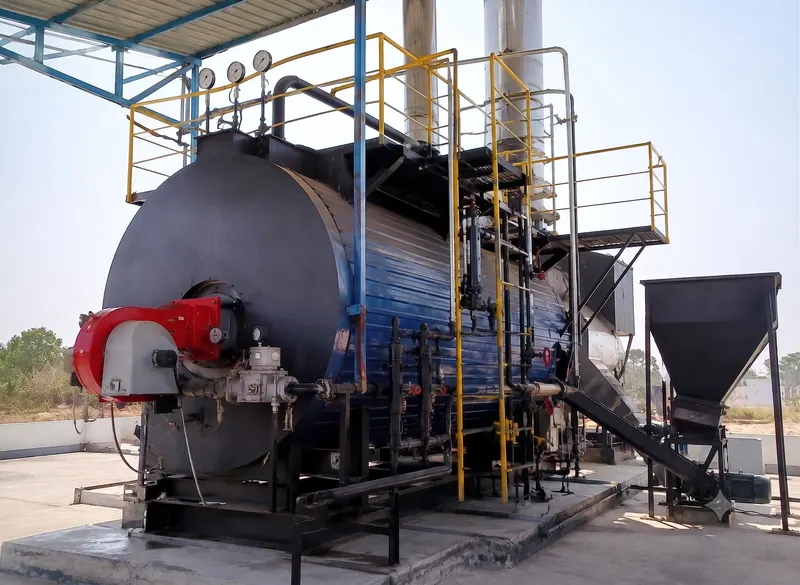
In a plant that raises its own process steam on coal, the boiler is usually the largest single entry on the counted list — larger than its grid electricity, and at most process plants the only significant source of direct emissions. Every tonne of coal it burns arrives in the intensity figure; every tonne of husk it burns does not. A paper mill or a textile process house trying to move its intensity by five percent has very few places to look that matter as much.
The arithmetic is simple enough to do on the back of an envelope. Take an illustrative plant whose coal-fired boiler accounts for 70% of its counted emissions, with grid electricity making up the rest. To cut intensity by 5% at the same output, it must remove 5% of its total counted tonnes — which is about 7% of the boiler's (0.05 ÷ 0.70). Replace about 7% of the boiler's coal heat with biomass and, on the scheme's own counting rules, the target is met. The numbers are an example; your own shares come out of your fuel and electricity records.
Three levers on the boiler
Fuel switching. Because biomass is reported separately and not counted, displacing coal with rice husk, wood chips, briquettes or other biomass reduces counted emissions in proportion to the coal heat displaced. On a grate or fluidized bed boiler, co-firing a share of biomass is often possible with changes to fuel handling and feeding rather than a new boiler; a full switch, or an older boiler not designed for biomass, may need more. The practical limits are supply, moisture and ash behavior, not the rules — and a plant switching fuel should plan its fuel yard as carefully as its boiler.
Efficiency. Every point of boiler efficiency is fuel that is not burnt, and on fossil fuel that is counted tonnes not emitted. Taking a boiler from 80% to 84% efficiency cuts its fuel by nearly 5% — 1 − 80/84 — before any change of fuel at all. The usual sources are the ones covered in our article on boiler efficiency: excess air, stack temperature and an economizer, blowdown, and scale on the water side.
Steam demand. The cheapest tonne is the steam the process never asks for. Returning condensate, fixing failed traps and insulating distribution lines all reduce how much steam the boiler has to raise for the same production, which lowers intensity without touching the boiler at all. Our condensate recovery and steam cost calculators under Tools put numbers on those for a specific plant.
Measure before you argue
The intensity figure is only as good as the fuel data behind it. The procedure lets a plant use default emission factors or its own, and asks it to strive for its own where a fuel contributes significantly, which means representative sampling and laboratory analysis of calorific value and composition. A plant that knows its coal's real net calorific value, weighs its fuel properly and meters its steam is in a far stronger position — with its verifier and with its own investment decisions — than one working from invoices and defaults.
That is also where to start. Establish what the boiler actually burns and actually delivers, find the losses, and only then decide between biomass, an economizer and a condensate project. An audit that measures stack losses, blowdown, trap performance and condensate return gives the numbers to rank them against the target you have been given.